
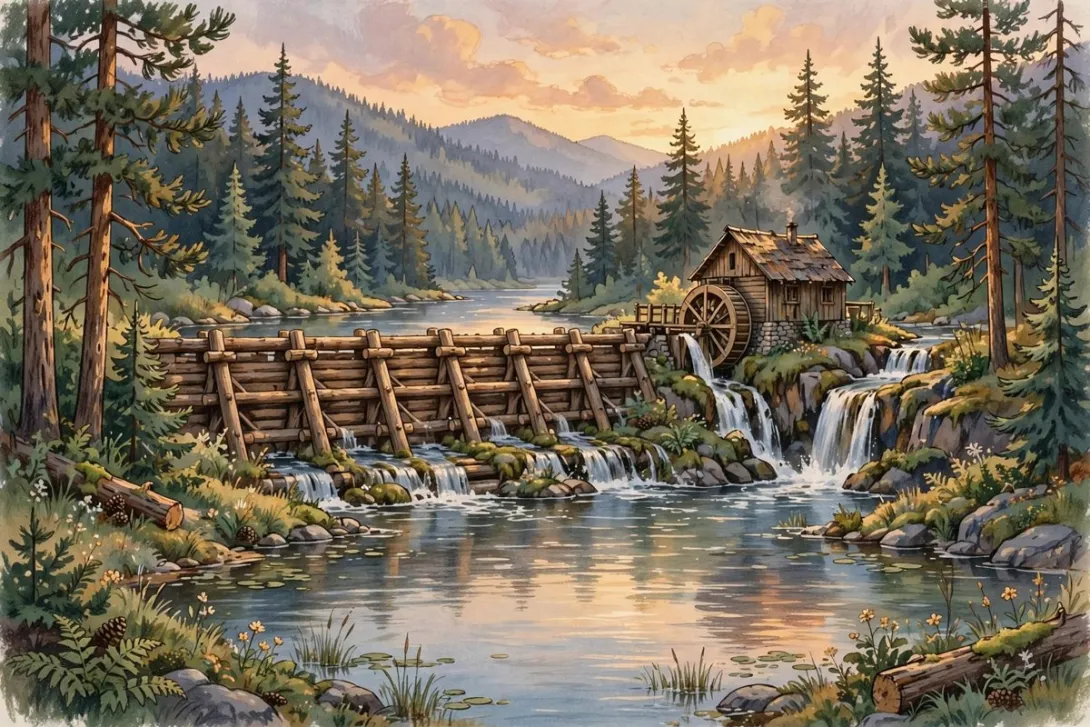
From the quiet shore at Black Bay, it is easy to forget that Post Falls began as a working river town, built around timber and falling water. Just downstream from where the Spokane River leaves Coeur d'Alene Lake, the river splits into three channels, each with its own natural falls, before the channels join again. Frederick Post saw what that drop could do. He secured rights at the falls, built a sawmill, and laid a dam across the north channel to turn the river toward his mill.
That first dam was itself a piece of logging craft. It was a timber-crib dam, about 20 feet high and several logs thick, built in layers — long logs laid one way, connected by layers of shorter logs set across them. It had no head gates, so in times of high water the river simply flowed over the whole structure. The sawmill it served was finished in 1880, and around it grew a small mill complex: a planing mill and a lath mill, and a sash and door factory turning rough timber into finished pieces for new homes and businesses.
For families living along the river, including those who would one day know this stretch as Black Bay's neighborhood, the mill was more than a building. It was work, wages, and the reason a town existed here at all. Lumber shaped the houses people lived in, and the steady work at the falls gave Post Falls its first real center of gravity, long before the subdivisions and parks that line the river today.
Then, in 1902, the mill was destroyed by fire. One detail from that year tells the story best: the mill burned, but the log dam was undamaged. The timber structure that Post's crews had stacked in the north channel, the very thing built to hold back and direct the river, stood through the blaze that took the mill it powered.
The loss hit the young town hard and fast. Post Falls had claimed a population of about 600 people. Within two months of the fire, accounts from the era record, it had dwindled to less than half that number. When a mill town loses its mill, people do not wait around — they follow the work, and a place built around a single industry can empty almost overnight.
Standing at Black Bay today, none of that drama is obvious. The river moves calmly past homes and parkland, and the falls upstream are known now for power and scenery. But the fire of 1902 is a good reminder of how fragile the first Post Falls was — and how much of it rested, quite literally, on stacked logs in a river channel, holding steady after the mill beside it was gone.
- Log in to post comments