
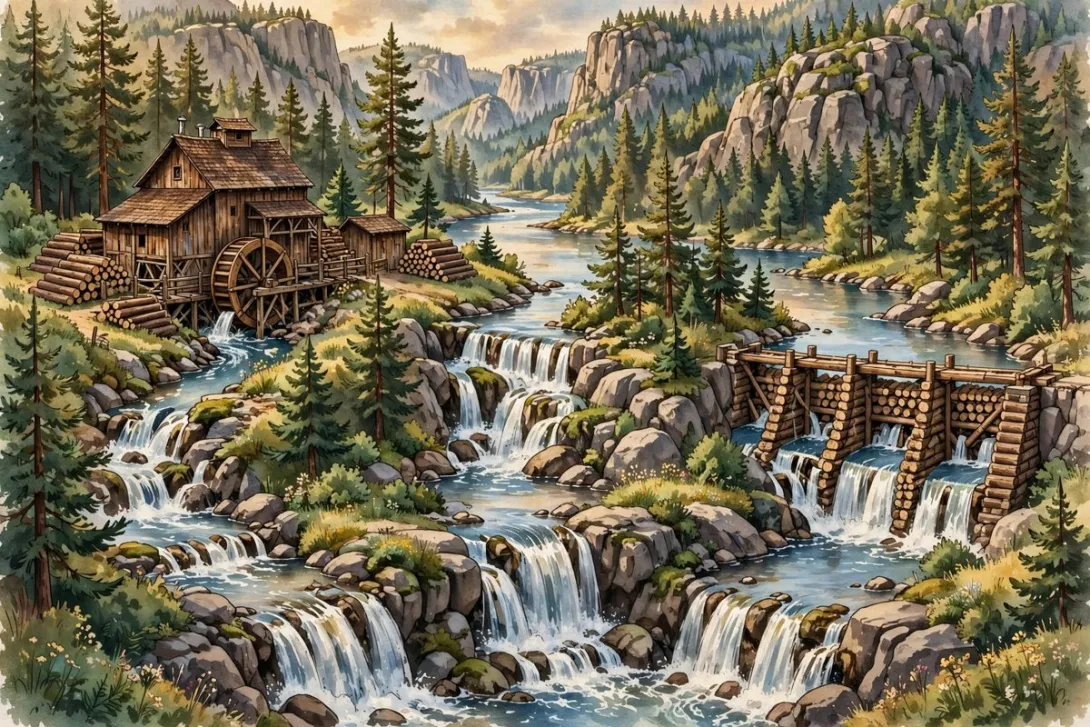
About nine miles west of Coeur d'Alene Lake, the Spokane River does something dramatic. It splits into three channels, each one tumbling over a natural falls, and then gathers itself back together just downstream. For neighbors in Black Bay, that drop is part of the familiar sound and scenery of the river. Long before there was a town here, it was the falls themselves that drew attention, and one man who decided to build his future beside them.
Early visitors did not yet call the place Post Falls. The falls were known as the Upper Falls, and also as the Little Falls of the Spokane River, a name that lingered for years. As late as 1886, a newspaper account of railroad construction across the prairie was still referring to the spot as Little Falls, and the community did not get a post office until 1887. The name, like the town, was still taking shape.
That began to change on June 1, 1871. Frederick Post, a German immigrant, reached an agreement with Andrew Seltice, a prominent Coeur d'Alene leader, for more than 200 acres of Spokane River land where he hoped to start a mill. The two recorded the cession on a prominent rock beside the falls, an inscription that can still be seen at Treaty Rock Park. There is no record that money changed hands, but the agreement was later included in a treaty between the Coeur d'Alene Tribe and the United States government, signed in 1889 and ratified in 1891, which recognized Post's rights to develop water power on both sides of the river.
Post's start was not a smooth one. He began work on a mill in 1871, then left before finishing it and moved to Spokane Falls. What makes his story memorable is that he came back. He returned in 1879, and by the following year a sawmill was operating at the falls. To put the river to work, he built a timber-crib dam across the north channel, about 20 feet high and several logs thick, to divert water toward the mill. It was practical, hard work, done with timber, rock, and persistence.
In time, people stopped reaching for the older names. Little Falls gave way to Post's Falls, and then simply to Post Falls, in honor of the mill builder who had returned to finish what he started. The falls that once marked a stretch of river on a map became the heart of a townsite, and later an important power site. Stand near the river today, with Black Bay and the wider community close by, and it is easy to see what Post saw in 1871: falling water, ready timber, and a place where a community could grow.
- Log in to post comments